


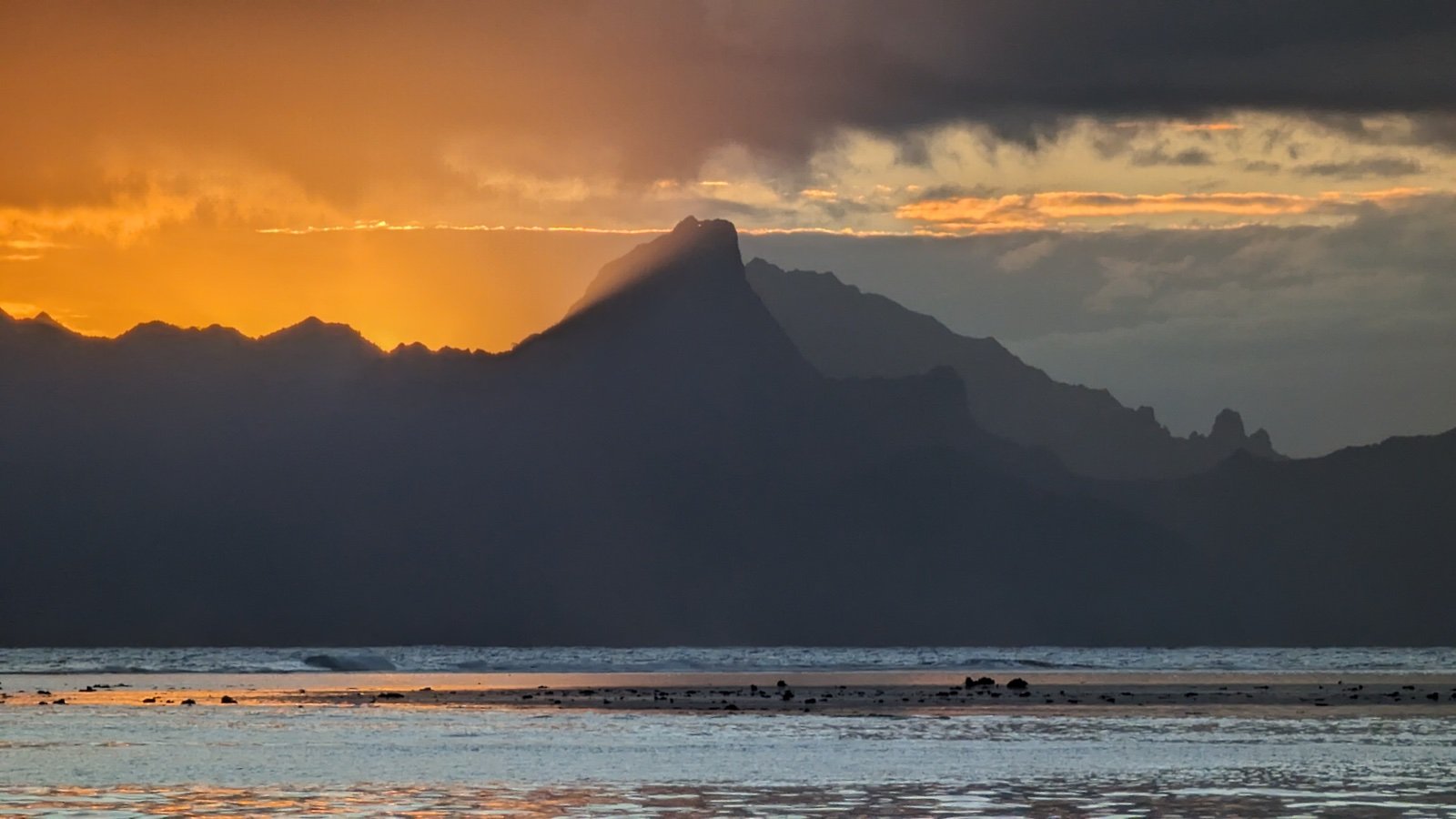
Before maps, before books, there was the spoken word. In Polynesia, the story of the world was never written down: it was sung, passed on, danced, from one generation to the next. The mountains, the passes, the eels in the rivers, the moon itself… here, every part of the fenua carries a legend.
Here are a few of the great ma’ohi stories. Not mere folktales, but a living heritage, still present in place names and family memory. Enough to make you look at the fenua differently, next time you raise your eyes toward a mountain.
Ta’aroa, the creator in his shell
In the beginning, there was no sky, no earth, no sea. Only Ta’aroa, alone in the darkness, enclosed in his cosmic shell named Rumia.
After ages of silence, Ta’aroa broke his shell. From its upper part he made the sky; from its lower part, the earth. Then he shaped the world with his own flesh: his back became the mountains and rocks, his spine the mountain ranges, his tears the oceans, rivers and clouds. From his sacred body were finally born the atua (the gods), then humankind.
Ta’aroa — Tangaroa elsewhere in Polynesia — is the original god, the one from whom everything flows. His legend, recorded as early as the 19th century, is one of the most complete cosmogonies in the Pacific.
Māui, the demigod who defied the sun
If Polynesia needed a hero, it would be Māui. This clever, daring demigod is famous across the whole Polynesian triangle, from Tahiti to Hawai’i and Aotearoa (New Zealand).
He is credited with two feats. First, slowing the sun: the days were too short, the sun raced across the sky. Māui lassoed it and forced it to slow its course — giving people days long enough to work, fish and live. Then, fishing up the islands: with a magic hook, he is said to have pulled whole lands from the depths — an image that tells, in its own way, how the islands rose out of the ocean.
Māui is intelligence and daring in the service of people.
Hina, the moon, the eel and the birth of the coconut tree
Hina is one of the most tender and ever-present figures in Polynesian mythology, often linked to the moon.
One of her most famous legends tells the origin of the coconut tree. Hina, a young princess from Papeari, is promised to a prince who turns out to be a giant eel, lord of Lake Vaihiria. Frightened, she flees to the peninsula, to Vaira’o, where she finds refuge with the god Māui.
The eel is eventually beheaded; Māui entrusts its head to Hina, warning her never to set it down on the ground. One day, Hina forgets: the moment she puts it down, the earth opens and swallows the eel’s head. Soon a plant springs up and rises toward the sky: the first coconut tree, tumu ha’ari.
That is why, they say, the coconut still bears three dark marks: the two eyes and the mouth of the eel. And the silhouette of the palm evokes the eel standing upright. 🥥
Also on Anoe: Puhi tari’a, the sacred eels of the valleys — the eel is a sacred animal, recurring in the legends of the fenua.
Hiro, the great navigator of Ra’iatea
Hiro is the navigator-hero par excellence, often presented as the god of sailors and thieves, born on Ra’iatea, the sacred island. Cunning and powerful, he embodies the Polynesian art of long-distance voyaging and the great expeditions between islands.
And his reputation as a “thief” opens one of the most beautiful legends of the Windward Islands…
Pai and the spear that pierced the mountain of Moorea
One night, Hiro and his band land from Ra’iatea on Eimeo — the old name of Moorea — with a bold plan: to steal Mount Rotui. They tie long pohue vines to its summit and begin to pull, to tear the mountain away. Moorea’s two bays, they say, still bear the trace.
But in Punaauia, on Tahiti, the warrior Pai is woken by his adoptive parents, warned in a dream: “Take your spear Rufautumu and throw it toward Aimeo.” Pai climbs the Tata’a hill, from which the view of Moorea is perfect, and hurls his spear of purau wood. It crosses the sea in a flash and pierces a summit — since called Mou’a Puta, “the pierced mountain.” Continuing its course like a meteor, the spear flies on to Ra’iatea and lodges there.
The hole in Moorea’s mountain is there to prove it. 🗻
‘Oro, Taputapuātea and “Tahiti, the fish”
On Ra’iatea stands the great marae Taputapuātea, spiritual heart of Polynesia and cradle of the cult of the god ‘Oro, god of war and fertility. From here the great canoes set out, carrying not only people and provisions but also their gods and their legends, to Hawai’i and Aotearoa. Taputapuātea is today inscribed on the UNESCO World Heritage list.
Another tradition tells that Tahiti is a fish: Tahiti Nui, the large island, and Tahiti Iti, the peninsula, would trace the body and tail of a fish that once tried to break free and swim toward other horizons.
Also read: The marae of Polynesia, at the heart of ma’ohi culture and Understanding the Mana.
Living the legends today
These stories don’t sleep in the past: they live on in place names, in ‘ori tahiti, in the chants of the Heiva, in the words of the tupuna. To discover them is to see the mountains and lagoons differently — and to feel a little more strongly what it means to live the fenua.
To go further: On the trail of the legends: an 8-day itinerary in Polynesia · The ‘Arioi Centre: dive into the heart of Polynesian culture.
To go further
- Teuira Henry, Ancient Tahiti (Bishop Museum, 1928).
- Bruno Saura, Un poisson nommé Tahiti. Mythes et pouvoirs aux temps anciens (Au Vent des Îles); Les 100 légendes de la mythologie polynésienne.
- Tahiti Heritage — tahitiheritage.pf.
- Musée de Tahiti et des Îles – Te Fare Iamanaha.

About the author
Ruben Chang is passionate about his homeland, his fenua, the sounds and stories that move him. Creator of tahiti-agenda.com in 2007 and front-end developer for the REDSOYU agency, he explores the cultures, technologies and stories that link the islands on a daily basis.