


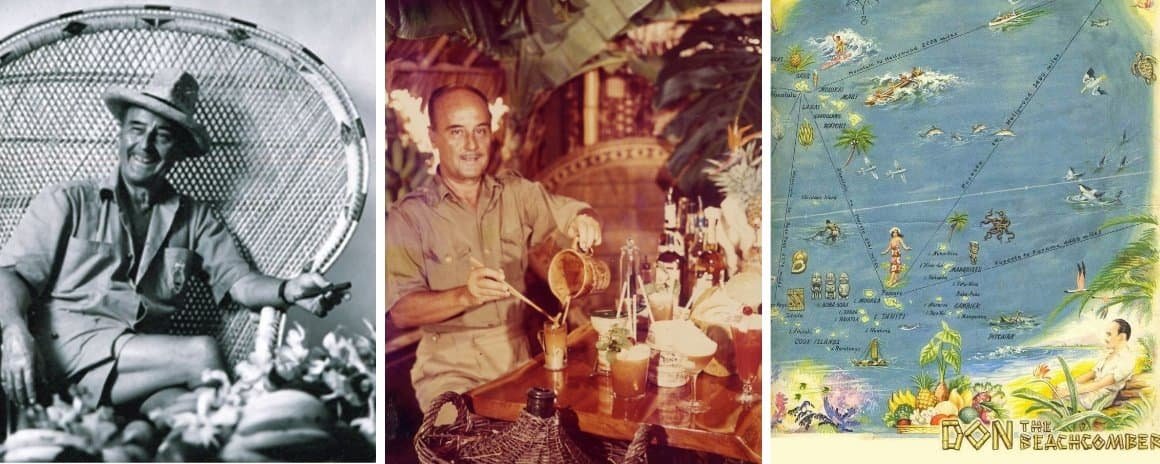
When the name Don the Beachcomber (1907–1989) comes up, it usually sparks images of floral shirts and legendary Zombie or Mai Tai cocktails. It’s true—Ernest Gantt (who legally became Donn Beach) is the founding father of the “Tiki” culture that once swept across America.
But for those of us here in the Fenua, the story is quite different. It isn’t just the tale of a world-famous bartender; it’s the story of an inventor and an ocean lover who spent his final years in Moorea with a wild ambition: to reinvent life on the water.
Today, thanks to rare archives from 1976, I’m taking you on a journey to discover his ultimate dream: the “Floating Fare.”
1929-1933: The birth of a legend
It all began with a journey. Born in New Orleans, Ernest Gantt made his first visit to Tahiti in 1929 while en route to Hawaii on a cruise ship. He fell head over heels for “everything Pacific.”
He returned to the United States with one obsession: recreating that island magic.
The world’s first “Tiki Bar” (Los Angeles)
In 1933, as Prohibition came to an end, he opened a tiny bar in Hollywood on McCadden Place, simply named “Don the Beachcomber”. He decked out the space with treasures from his travels: weathered fishing nets, driftwood, and Polynesian spears.
While the Hollywood elite were sipping champagne, Donn offered a total escape with his “Rum Rhapsodies”—complex cocktails designed to wash away urban stress. The success was metevolent, providing the funds he needed to head back to the “real” paradise.
🔗 For the history buffs:
The story of the original bar and its vintage menu: Atomic Grog History
- Read more on Anoe: Tiki Culture: The Hollywood Dream vs. the Reality of Tahiti’s Islands
- Read more on Anoe: The Overwater Bungalow: The Invention that Changed “Paradise”
From New Orleans to the Southern Lagoons
Donn’s love affair with the Pacific was no passing fling. Born in New Orleans, he first stepped foot on Tahitian soil back in 1929 during a sea voyage, well before the end of Prohibition in the United States.
After amassing a fortune in Hollywood and Waikiki with his famous International Market Place, he decided to return to the source. He was done with cardboard movie sets; he craved the authentic Pacific.
As he shared with the Honolulu Star-Bulletin: “It’s my own little world of escape… A place where you want to be alone or just with friends.”
Project “Marama”: A Masterpiece of Naval Architecture
This is where the story becomes truly fascinating for fans of architecture and seafaring. Donn Beach didn’t want to build just another hotel on the beach. He collaborated with Herb Kane, the renowned artist and vice president of the Polynesian Voyaging Society (the very same people who revived traditional navigation with the Hōkūleʻa canoe), to design a unique vessel.
This boat, often referred to as the Marama, was a prototype for a floating Tahitian Fare:
Dimensions: A 42-foot catamaran (roughly 13 meters) boasting a living space of 800 sq ft (74 m²).
Design: It resembled a traditional thatched-roof hut but was packed with modern comforts: a fully equipped kitchen, a full bathroom, and wall-to-wall carpeting.
Major Innovation: In the center of the living room sat a glass-bottom table with a removable top, allowing guests to view and touch the lagoon water without ever leaving the sofa.
💡 For naval history enthusiasts: You can view rare photos of this houseboat and its construction on the specialized site Don Beachcomber’s Marama History.
A Visionary Philosophy: “Reversing the View”
Why live on the water? In his 1976 interview, Donn Beach theorized the very concept that would later cement the success of overwater bungalows—though his particular vision was entirely mobile.
His idea was simple yet brilliant:
“Visualize yourself on a lagoon… Instead of looking out from a hotel room on an island toward the sea, the situation is reversed.”
He wanted visitors to be able to admire “a palm-fringed beach, white sand beneath towering green mountains” from the perspective of the ocean, completely secluded 200 or 300 yards from the shore.
His initial plan was ambitious: to tow this prototype to Tahiti and create a fleet of 50 floating fares anchored in the lagoons of Moorea and Bora Bora.
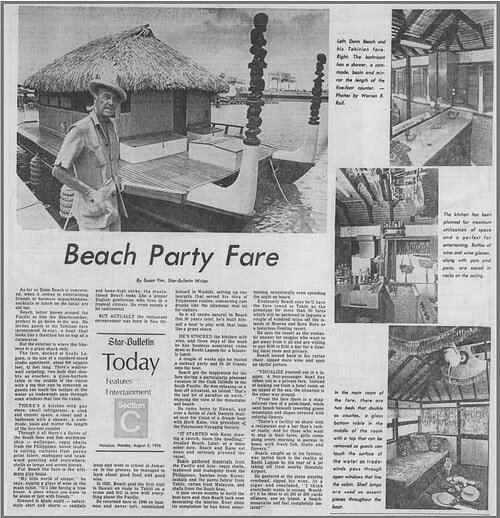
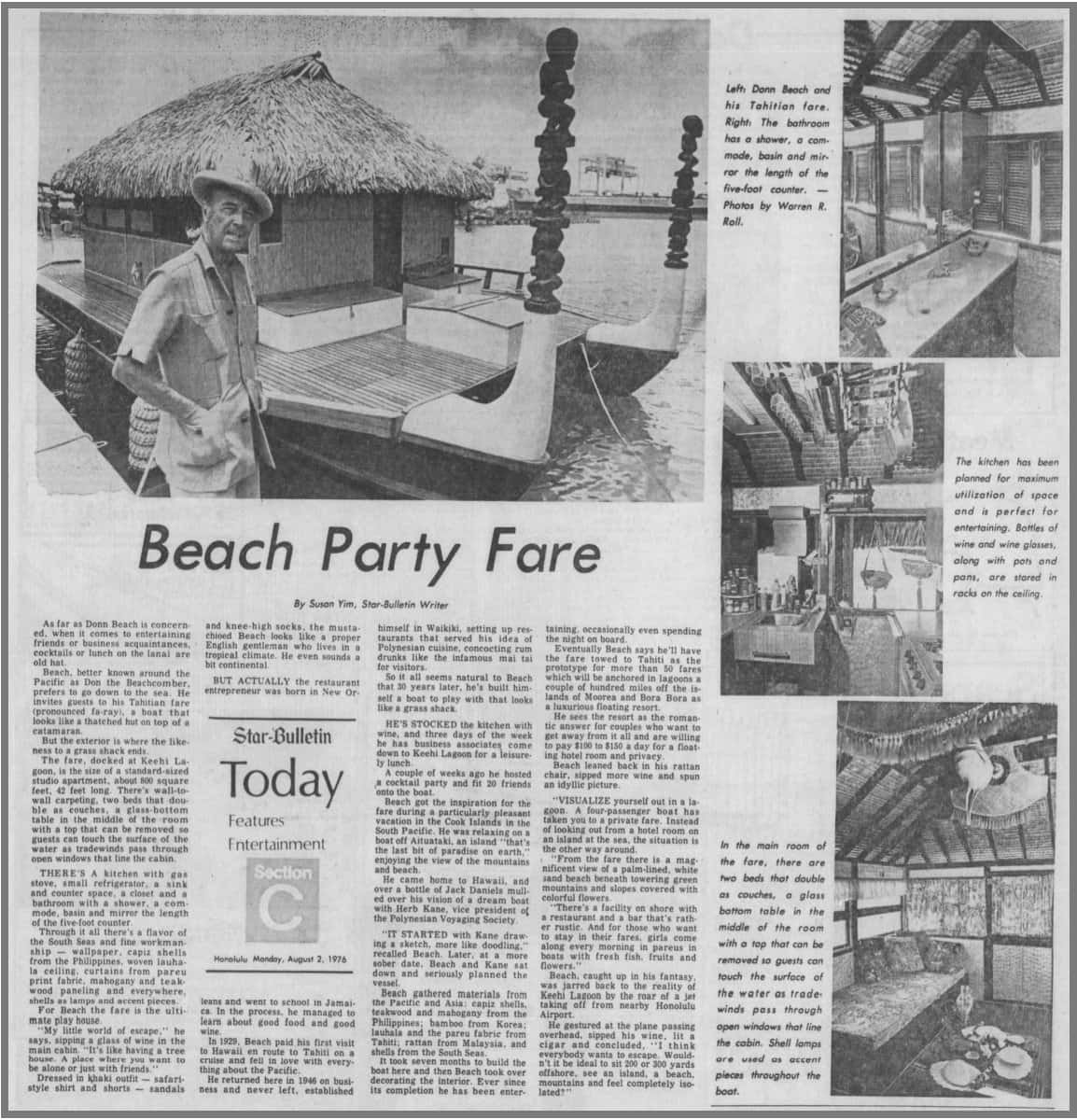
By Susan Yim, Star-Bulletin Writer
Honolulu, Monday, August 2, 1976
📸 PHOTO CAPTIONS (Right Column)
Top left: Donn Beach and his Tahitian fare.
Top right: The bathroom features a shower, commode, washbasin, and a full-length mirror across the five-foot counter. — Photos by Warren R. Roll.
Middle right: The kitchen was designed for maximum space utility and is perfect for entertaining. Wine bottles, glasses, and cookware are conveniently stored in overhead ceiling racks.
Bottom right: In the main cabin of the fare, two beds double as sofas. A glass-bottom table sits in the center of the room with a removable top so guests can touch the water’s surface as the trade winds drift through the open windows. Shell lamps serve as decorative accents throughout the vessel.
📝 ARTICLE BODY
[Columns 1 & 2]
For Donn Beach, the days of hosting friends or business associates for cocktails or lunch on a standard lanai are a thing of the past.
Beach, better known across the Pacific as Don the Beachcomber, now prefers to take his guests out to sea. He invites them aboard his Tahitian Fare (pronounced fa-ray), a vessel that looks like a thatched-roof hut perched upon a catamaran.
But the resemblance to a rustic shack ends the moment you step inside.
The fare, currently moored at Keehi Lagoon, is roughly the size of a standard studio apartment—about 800 square feet (74 m²) and 42 feet (13m) long. It features wall-to-wall carpeting, two beds that serve as lounges, and a glass-bottom table in the center of the room with a removable top, allowing guests to reach down and touch the lagoon water while the trade winds sweep through the open cabin windows.
The layout includes a kitchen with a gas range, a small refrigerator, a sink, and workspace, alongside a closet and a bathroom equipped with a shower, commode, washbasin, and a full-length mirror.
Everywhere you look, the flavor of the South Seas is met with refined craftsmanship—wall coverings, Philippine capiz shells, woven lauhala ceilings, pareu (pareo) fabric curtains, mahogany and teak woodwork, and shells repurposed as lamps and decorative art.
To Beach, the fare is the ultimate playhouse.
“It’s my own little world of escape,” he says, sipping a glass of wine in the main cabin. “A place where you want to be alone or just with friends.”
Dressed in his signature khaki—a safari-style shirt and shorts—with sandals and high socks, the mustachioed Beach looks every bit the proper English gentleman living in the tropics. He even carries a slightly continental air about him.
[Column 3]
IN REALITY, however, the restaurant entrepreneur was born in New Orleans and attended school in Jamaica. Along the way, he mastered the art of fine food and even finer wine.
In 1929, Beach made his first visit to Hawaii while en route to Tahiti on a cruise ship, falling instantly in love with everything related to the Pacific.
He returned in 1946 for business and never left, establishing himself in Waikiki and creating restaurants that served his unique vision of Polynesian cuisine, concocting rum-based drinks like the legendary Mai Tai for island visitors.
It seems only natural, then, that after 30 years, Beach has built himself a pleasure craft that resembles a grass shack.
HE KEEPS THE KITCHEN well-stocked with wine, and three days a week, business associates head down to Keehi Lagoon for a leisurely lunch.
A few weeks ago, he hosted a cocktail party, comfortably fitting 20 friends on board.
Beach found the inspiration for the fare during a particularly pleasant holiday in the Cook Islands. He was relaxing on a boat off Aitutaki—an island he calls “the last piece of paradise on earth”—taking in the sweeping views of the mountains and the shore.
Upon returning home to Hawaii, over a bottle of Jack Daniels, he brainstormed his dream boat with Herb Kane, vice president of the Polynesian Voyaging Society.
“IT STARTED with Kane drawing a sketch, more like a doodle,” Beach recalls. Later, on a more sober occasion, Beach and Kane sat down to seriously engineer the vessel.
Beach gathered materials from across the Pacific and Asia: capiz shells, teak, and mahogany from the Philippines; bamboo from Korea; lauhala and pareu cloth from Tahiti; Malayan rattan and South Seas shells.
It took seven months to build the boat locally, after which Beach personally took over the interior decoration. Since its completion, he has been entertaining regularly, occasionally even spending the night at anchor.
[Column 4 – The Crucial Tahiti Connection!]
Eventually, Beach says he plans to have the fare towed to Tahiti as a prototype for more than 50 fares to be anchored in the lagoons, just a few hundred yards off the islands of Moorea and Bora Bora, serving as a luxury floating hotel resort.
He envisions the resort as the romantic answer for couples who want to get away from it all and are willing to pay $100 to $150 a day for a floating hotel room and total privacy.
Beach leaned back in his rattan chair, took another sip of wine, and painted an idyllic picture.
“VISUALIZE YOURSELF on a lagoon. A four-passenger boat has whisked you away to your private fare. Instead of looking out from a hotel room on an island toward the sea, the situation is reversed.”
“From the fare, you have a magnificent view of a palm-fringed beach, white sand beneath towering green mountains and slopes covered in colorful blossoms.”
“There would be a shore facility with a rather rustic restaurant and bar. And for those who want to stay in their fares, girls in pareus would come by every morning in boats with fresh fish, fruit, and flowers.”
Beach, momentarily lost in his fantasy, was jolted back to the reality of Keehi Lagoon by the roar of a jet taking off from the nearby Honolulu airport.
He gestured toward the plane passing overhead, finished his wine, lit a cigar, and concluded: “I think—wouldn’t it be ideal to be sitting 200 or 300 yards offshore, seeing an island, a beach, mountains, and feeling completely isolated?”
A Life as a “Gentleman of the Tropics” in Moorea
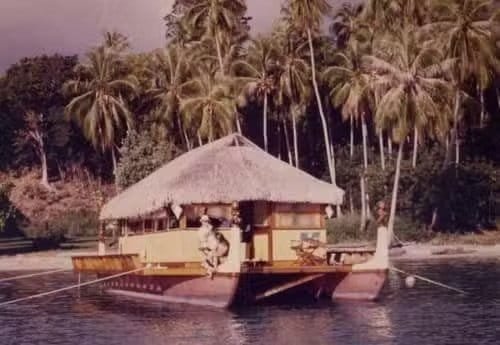
While the fleet of 50 vessels never materialized on an industrial scale, Donn Beach truly lived his dream. He successfully brought his prototype to French Polynesia.
He lived aboard, navigating through the waters of Cook’s Bay and Opunohu Bay. He decorated the interior with materials sourced from across the Pacific: Tahitian Pareu fabric, woven Lauhala for the ceilings, Philippine mahogany, and bamboo from Korea.
He hosted friends and business associates for memorable lunches, dressed in his signature khaki safari suit, cultivating his persona as a gentleman explorer until the very end of his life.
The Legacy Today
Ernest Gantt passed away in 1989 and rests at the National Memorial Cemetery of the Pacific in Honolulu, but his spirit still drifts across our waters.
Today, whenever you see leisure catamarans dropping anchor in Moorea’s lagoon, or when you stay in a retreat over the water, you are experiencing a piece of the vision he had before anyone else: a life centered on the beauty of the island as seen from the sea.
Want to dive deeper into Tiki culture? Be sure to visit the landmarks that keep this aesthetic alive, or immerse yourself in the definitive guides on Tiki Culture.
The Tiki Library: Essential Reading
If the story of Don the Beachcomber has sparked your curiosity, here are the must-read books (mostly in English, the movement’s original language) to dive deeper into the legend:
1. The Historical Bible: “Sippin’ Safari”
Author: Jeff “Beachbum” Berry
Why read it: This is THE definitive resource on Don the Beachcomber. The author spent years tracking down Donn’s former bartenders to reconstruct the history and decode the secret recipes (which were originally written in code to prevent theft!). It features rare archival photos and the most comprehensive biography of Ernest Gantt ever published.
👉 Reference link: Sippin’ Safari – 10th Anniversary Edition
2. The Visual Bible: “The Book of Tiki”
Author: Sven Kirsten
Why read it: Sven Kirsten is the urban archaeologist credited with rediscovering Tiki culture in the 90s. This book is a visual masterpiece, compiling menus, postcards, and architectural photography (including the Tahara’a and Donn’s various projects). It is the very book that reignited the global Tiki craze.
👉 Reference link: Taschen – The Book of Tiki
3. Culinary Authenticity: “Hawaii Tropical Rum Drinks & Cuisine”
Authors: Don the Beachcomber & Phoebe Beach
Why read it: To cook just like they did aboard the Marama! This frequently reprinted book compiles the master’s classic recipes. Phoebe Beach, Donn’s wife who lived with him on the houseboat in Moorea (and who appears in our archival photos), played a vital role in preserving this culinary legacy.
👉 Availability: Often found as second-hand copies or new editions on Amazon.

About the author
Ruben Chang is passionate about his homeland, his fenua, the sounds and stories that move him. Creator of tahiti-agenda.com in 2007 and front-end developer for the REDSOYU agency, he explores the cultures, technologies and stories that link the islands on a daily basis.